
IC No. 48 - Mixed Feelings
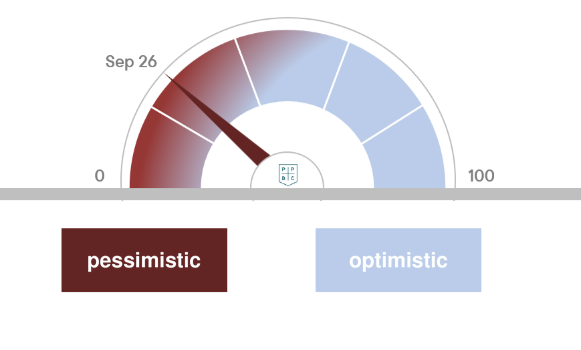
Capital markets are usually caught in a swirl of emotions between those who see the glass as half full and those who see it as half empty. The combination of optimists and pessimists keeps markets in balance. Occasionally, the pendulum swings between euphoria and panic. We are currently seeing increasingly concerned commentary on market conditions, which has prompted us to ask: is sentiment turning?
IC No. 48 - Mixed Feelings

Rising interest rates, high energy costs, the enormous capital requirements of AI and increasing concentration risks in capital markets give cause for concern. On the other hand, there are positive developments, for example in Europe’s industrial sector. More broadly, corporate earnings growth appears to be positive, supporting share prices. Let us look at the facts.
In mid-April 2026, investors were still optimistic thanks to the ceasefire in the Middle East. A look at our sentiment barometer[1] shows that investor sentiment has since become considerably more pessimistic. We find this reassuring, as sceptical investors are less prone to market excesses.
Investor sentiment far from euphoric
Prio Partners sentiment indicator
But how much breathing room do markets have if interest rates continue to rise?
Oxygen levels – is the air getting thinner?
For capital markets and the economy, liquidity is the vital oxygen that keeps everything running. As interest rates rise, the air gets thinner. Higher interest rates are intended to prevent the economy from hyperventilating and to limit the misallocation of capital.[2] Rising interest rates can be a positive signal when the economy is actually growing. However, if rates rise primarily because of increasing inflation, caution is warranted.
A sound economic environment
A look at the four-quadrant matrix shows that current data point to a sound economic environment.

This constructive environment allows central banks to reduce the oxygen supply slightly without choking the economy. The FED’s interest rate increase of +0.25% to 3.75–4% marks the first step this year.[3] Further tightening is expected, but the strong economic backdrop suggests that markets are coping well with the headwinds.
Kevin Warsh, who became Chair of the US Federal Reserve (FED) this year, cited three reasons at the press conference on 16 September: strong economic growth, increasing competition for capital and geopolitical tensions.
1. Strong economic growth: A robust economy increases demand for capital and therefore puts upward pressure on interest rates.
2. Competition for capital: The government and major technology companies simultaneously require large sums for investment and financing.
3. Geopolitical tensions: These can push up oil prices and, in turn, inflation and interest rates.
Rising interest rates can nevertheless pose a threat. The magnitude and pace of rate increases play an important role here. As investors, we need to pay attention to both. Let us now look at the state of the global economy to underpin our assessment of the current situation with further facts.
Solid growth
The International Monetary Fund forecasts solid global economic growth of +3.3% in 2026. Further investment in AI and the resulting efficiency gains could increase global growth by another +0.3%.[4]
Profitable companies
The picture brightens further when we look beyond the global economy to corporate earnings. Earnings growth is at historically high levels.
Profits are flowing
S&P 500 sector earnings growth: year-on-year quarterly change, 2025–2026
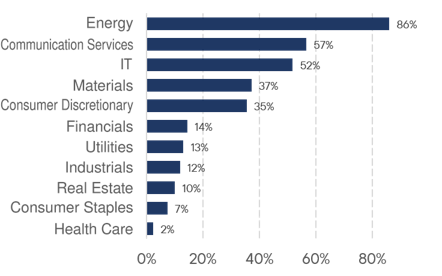
Energy (+86%), Communication Services (+57%) and IT (+52%) are clearly leading earnings growth. These same sectors also play the largest role in AI investment. “Global AI investment could reach USD 1,500 billion. Set against global GDP of around USD 110,000 billion, AI is becoming an important driver of global economic growth,” says our new partner and AI investment expert Can Elbi.
The world cannot get enough of artificial intelligence. There is no question that the future belongs to AI. As investors, however, we must still ask whether the astronomical investments in AI infrastructure will pay off. The upcoming stock market flotations of the two most important private companies in AI should provide greater clarity and concrete figures: OpenAI and Anthropic would be by far the largest flotations in capital market history, provided they actually take place.
The question remains whether this optimism has pushed prices too far. As investors, we assess valuations using the traditional price-to-earnings ratio.
Fair Valuations
In our view, current price-to-earnings ratios are at fair levels. This is primarily due to higher earnings.
The forward price-to-earnings ratio for the next twelve months is 17.8 for the global equity market and 19 for the S&P 500. Given earnings growth, neither is excessive; both are well justified. Today, the market is paying for real earnings power rather than mere fantasy. All in all, the picture looks almost rosy.
Not a fantasy premium
Forward price-to-earnings ratios (12 months)
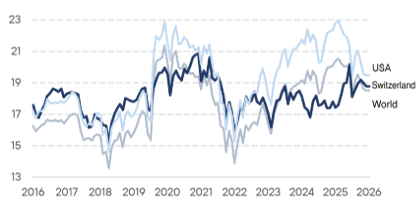
Switzerland remains particularly attractive to us. With a forward price-to-earnings ratio of 18, Swiss equities are close to their long-term average and, in our view, fairly valued. After all, investors are buying quality. Many Swiss companies are global leaders in their niches, combining innovation with pricing power and defending their margins over many years. This reliability is valuable in its own right in a volatile environment.
Conclusion
The situation has become more challenging. Rising interest rates and energy prices are weighing on the outlook, yet the underlying economic forces remain intact. Historic sums are flowing into AI infrastructure, nearshoring is bringing production back closer to end markets, and European industry is recovering after years of weakness. At the same time, AI is beginning to deliver tangible productivity gains and create real value from these investments. Growth therefore rests on several pillars, not just one. The broader environment also remains stable. Despite higher oil prices, inflation remains moderate, and central banks are adjusting interest rates in small steps. Meanwhile, companies continue to earn healthy profits. A market supported by rising earnings rests on solid foundations. We remain broadly invested across regions, sectors and companies. This allows us to participate in growth wherever it occurs and remain resilient should the pendulum swing back.
PC
[1] The Prio Partners Sentiment Barometer uses technical and fundamental data to gauge sentiment in the global equity market
[2] Investment Commentary No. 1 – What Is Worth What? 11.05.2016
[3] Federal Reserve FOMC Statement, 16.09.2026
[4] IWF: World Economic Outlook, January 2026